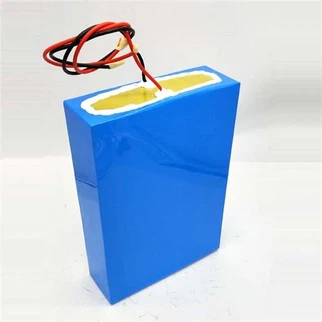
The full name of lithium iron phosphate battery is lithium iron phosphate lithium-ion battery, also called lithium iron phosphate power battery. The following describes the charging skills of lithium iron phosphate batteries.
The structure and working principle of lithium iron phosphate battery
As the positive electrode of the battery, LiFePO4 is connected with the positive electrode of the battery by aluminum foil. In the middle is a polymer separator, which separates the positive electrode from the negative electrode, but lithium ions can pass through but electrons cannot pass. The copper foil is connected to the negative electrode of the battery. Between the upper and lower ends of the battery is the electrolyte of the battery, and the battery is hermetically sealed by a metal casing. When a lithium iron phosphate battery is charged, lithium ions in the positive electrode migrate to the negative electrode through the polymer separator. During the discharge process, lithium ions in the negative electrode migrate to the positive electrode through the separator. Lithium-ion batteries are named after lithium ions move back and forth during charge and discharge.
Lithium iron phosphate battery charging process
When the battery is charged, lithium ions migrate from the surface of the lithium iron phosphate crystal to the surface of the crystal. Under the action of the electric field force, they enter the electrolyte, pass through the diaphragm, and then migrate to the surface of the graphite crystal through the electrolyte, and then are embedded in the graphite crystal lattice. . At the same time, electrons flow to the aluminum foil collector of the positive electrode through the conductor, flow to the copper foil collector of the negative electrode through the tab, battery pole, external circuit, negative pole, and negative lug, and then flow to the graphite negative electrode through the conductor. The charge on the negative electrode is balanced. After the lithium ions are deintercalated from the lithium iron phosphate, the lithium iron phosphate is converted into iron phosphate.
Discharge process of lithium iron phosphate battery
When the battery is discharged, lithium ions are extracted from the graphite crystals, enter the electrolyte, pass through the diaphragm, and then migrate to the surface of the lithium iron phosphate crystal through the electrolyte, and then re-embed into the lithium iron phosphate lattice through the surface. At the same time, the battery flows to the copper foil collector of the negative electrode through the conductor, flows to the aluminum foil collector of the battery positive electrode through the tab, battery negative pole, an external circuit, positive pole, and positive tab, and then flows to the iron phosphate through the conductor. Lithium cathode balances the charge of the anode.
Correct charging method for lithium iron phosphate battery pack
It is recommended to use the CCCV charging method for charging the lithium iron phosphate battery pack, that is, first constant current and then constant voltage. The recommended constant current is 0.3C. Constant voltage recommendation 3.65. That is 0.3C current charge in the constant current process. When the battery voltage reaches 3.65V, use a 3.65V constant voltage charge. When the charging current is lower than 0.1C (or 0.05C), stop charging, that is, the battery is already full. When you charge with a constant voltage power supply, you also need to look at the charging current. It is recommended not to charge with a voltage that is too high. After adjusting the voltage, ensure that the charging current is below 0.5C, which is good for the battery.
Generally, the upper limit voltage of lithium iron phosphate battery charge is 3.7~4V, and the lower limit voltage of discharge is 2~2.5V. The five aspects of discharge capacity, median discharge voltage, charging time, constant current capacity percentage, and safety are considered. Constant current and constant voltage are adopted. For the lithium iron phosphate battery pack, it is reasonable to set the charging limit voltage at 3.55~3.70V, the recommended value is 3.60~3.65V, and the lower limit voltage of discharge is 2.2V~2.5V.
The charger of the lithium iron phosphate battery pack is different from an ordinary lithium battery. The highest termination charging voltage for lithium batteries is 4.2 volts; the lithium iron phosphate battery pack is 3.65 volts. When charging a lithium iron phosphate battery pack, it is connected to the balance charging board. Generally, it is directly charged in series from both ends. The charger voltage is greater than the battery pack voltage. The cable detection of the voltage of every single cell is equivalent to connecting a Zener tube in parallel. The charging voltage of the single-cell will not exceed the voltage stabilization value, while other single cells continue to be charged through the Zener tube bypass.
Because the power of each cell is nearly full at this time, it is just balancing each cell, so the charging current is small, and each cell is fully charged to supplement the balance. The charger can only protect the terminal voltage of the entire battery pack. The balanced charging board ensures that each cell is overcharged and each cell is fully charged. It cannot stop charging the entire lithium battery pack because one cell is fully charged.