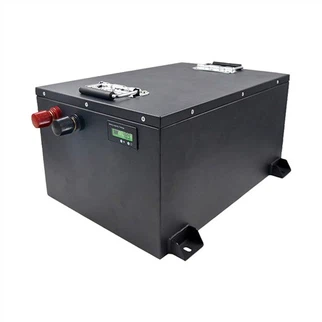
Compared with lead-acid batteries or gel batteries in the past, the lithium batteries commonly used nowadays are better in terms of specific energy, specific power, etc., and it is easier to achieve rapid charging and deep discharge, and the lifespan is longer. We have brought a better light experience.
However, there are differences between the quality of lithium batteries. Today we will start with their packaging form to see what are the characteristics of these lithium batteries, and which is better. The packaging forms often include cylindrical winding, square stacking, and so on. There are three types of square winding.
1. Cylindrical winding type
It is a cylindrical battery, which is a classical battery configuration. The monomer is mainly composed of positive and negative electrodes, a separator, a positive and negative electrode collector, a safety valve, an overcurrent protection device, an insulator, and a shell. The shell There were many steel shells in the early days, and many of them now use aluminum shells as raw materials.
Divided by size, there are now 18650, 14650, 21700, and other types of batteries. Among them, 18650 is the most common and the most mature technology.
Advantages: Cylindrical batteries have the best history of development, with a high degree of standardization, and it is easy to achieve uniform standards in the industry. The automation level of cylindrical battery production is higher than that of other types of batteries, which ensures the high efficiency of cylindrical battery production. The consistency of the body, on the other hand, also reduces production costs.
In addition, the cylindrical battery cell itself has better mechanical properties. Compared with the other two batteries, it can exhibit the highest bending strength under similar dimensions.
Disadvantages: As the battery required by solar street lights, it is not a single cell. It often needs to be composed of battery packs to work. The cylindrical shape has low space utilization and poor radial heat conduction will cause temperature distribution problems. In this environment, The probability of a large number of battery cell characteristics will increase.
In addition, many cylindrical batteries nowadays use a steel shell as the shell. When the battery pack is formed, the weight will be heavier, and the space for the increase in energy density is also very small.
2. Square winding type
This battery cell is mainly composed of a top cover, a case, a laminate or winding composed of a positive plate, a negative plate, and a separator, insulators, safety components, etc., and a needle-punched safety protection device (NSD) and Overcharge safety protection device (OSD), the shell is usually steel shell in the early days, and now the aluminum shell has become the mainstream.
Advantages: The prismatic battery packaging has high reliability and higher space utilization; the system has high energy efficiency, with similar dimensions, the weight is also higher than that of cylindrical batteries, and the energy density is higher; the structure is relatively simple, and the expansion is relatively easy It is more convenient. If you want to increase the energy density by increasing the monomer capacity, this kind of battery is more suitable.
The unit capacity is large, and the system configuration is relatively simple, making it possible to monitor the units one by one. Coupled with the design of NSD and OSD, it is safer and more reliable to use. In addition, the relatively simple system configuration makes it stable Sexual performance is also better.
Disadvantages: This kind of battery can be customized according to specific needs (mainly in terms of size), so the models of square batteries on the market are not unified, and this inconsistency also makes it difficult to unify the process. The quality of the batteries that came out was uneven.
The level of production automation is not high, the monomers are quite different, and the battery pack may be used to form a battery pack, and there may be a problem that the battery pack life is much lower than the life of the monomer.
Three, square stack type
This is the soft-pack battery that we often talk about. The basic structure of this battery is similar to the above two types of batteries. It consists of positive and negative electrodes, separators, insulating materials, positive and negative electrode tabs, and a shell. The single-piece positive and negative plates are wound differently, and the laminated battery is composed of multiple layers of pole pieces.
Among them, the shell is mainly aluminum plastic film. The outermost layer of this material structure is a nylon layer, the middle is an aluminum foil, and the inner layer is a heat-sealing layer. Each layer is bonded with an adhesive. This material has good ductility, flexibility, and mechanical strength, and it has good ductility, flexibility, and mechanical strength. It also performs very well in terms of performance and heat-sealing performance and is also resistant to electrolyte and strong acid corrosion.
Advantage
The soft pack battery adopts a superimposed manufacturing method, so the volume is thinner, the energy density is the highest, and the thickness is relatively thin, generally no more than 1cm. It is better than the other two in terms of heat dissipation performance, and under the same capacity, it is soft The package battery is about 40% lighter than the steel shell lithium battery and 20% lighter than the aluminum shell battery.
There are also many pole pieces. Each pole piece has a flange and the tabs are welded together. The current density distribution on the pole plate is uniform, and the heat is evenly distributed during the charging and discharging process. Moreover, it is a thin-sheet design, which is easy The modules and battery packs are also very efficient in space utilization and flexible in terms of size changes. The shape is not limited to squares and can be well adapted to different spaces.
Disadvantage
The shell strength of the soft pack battery is not as strong as the other two batteries with aluminum shell or steel shell as the shell, and it is very dependent on the group technology. Moreover, after long-term use, the reliability of aluminum-plastic film packaging is relatively good. It is difficult to guarantee that the battery body is relatively soft, and the contact impedance between the pole pieces may be relatively large, which needs to be solved at the module level or the battery pack level, which increases the technical difficulty.
Like the square battery, although it is more flexible in size and can adapt to different spaces, at the same time it is more difficult to unify the standardization of the process, so the quality of the made is also relatively uneven.
The consistency of the battery is also poor. If the battery is operated in an internal environment with insufficient heat transfer such as insulation or high temperature, the temperature of the battery will rise significantly, resulting in the formation of a "hot spot" inside the battery pack, which poses a safety hazard.
Briefly
1) Cylindrical batteries (cylindrical winding type), generally use steel shells, but also aluminum shells. The technology is relatively mature, small size, flexible grouping, low cost, mature technology, and good consistency; after grouping, the heat dissipation is not well designed, the weight is heavy, and the specific energy is low.
2) For prismatic batteries (square wound type), steel shells were the majority in the early days, and aluminum shells are now the majority. Good heat dissipation, easy design in groups, good reliability, high safety, including explosion-proof valve, high hardness; high cost, multiple models, difficult to unify the level of technology, is one of the mainstream technical routes.
3) Soft pack battery (square laminated type), aluminum-plastic film as the outer packaging, the size change is relatively flexible, the specific energy is high, the weight is light, the internal resistance is relatively small; the mechanical strength is relatively poor, the sealing process is difficult, the group structure is complicated, and the heat dissipation Poor design, no explosion-proof device, easy to leak, poor consistency, and high cost.