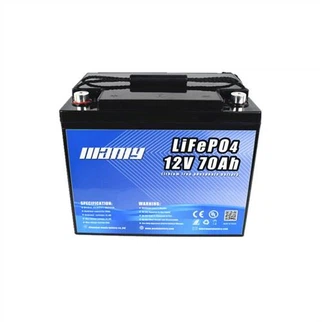
What is a lithium polymer battery?
Lithium polymer battery is a lithium-ion battery that uses a polymer as the electrolyte, specifically divided into "semi-polymer" and "full polymer".
The "semi-polymer" refers to a layer of polymer (usually PVDF) coated on the isolation film to make the cell more adhesive and the battery more rigid, while the electrolyte is still a liquid electrolyte. All-polymer" means that the polymer is used to form a gel network inside the cell, and then the electrolyte is injected to form the electrolyte. Although "all-polymer" batteries still need to use liquid electrolyte, but the amount is much less, which has greatly improved the safety performance of lithium-ion batteries. As far as I know, only SONY is now in mass production of "all-polymer" lithium-ion batteries.
From another point of view, polymer batteries are assigned with aluminum-plastic packaging film as the outer packaging of lithium-ion batteries, which is commonly known as soft pack batteries. This packaging film consists of three layers, respectively, PP layer, Al layer and nylon layer, because PP and nylon are polymers, so this kind of battery cell is called polymer batteries.
Lithium battery
"Lithium batteries are a class of batteries that use a non-aqueous electrolyte solution with lithium metal or lithium alloy as the anode material. lithium metal batteries were first proposed and studied by Gilbert N. Lewis in 1912. lithium ion batteries were proposed and studied by M. S. Whittingham in the 1970s. . Because the chemical properties of lithium metal is very lively, making the processing, preservation and use of lithium metal, the environmental requirements are very high. With the development of science and technology, lithium batteries have now become the mainstream.
Lithium batteries can be broadly divided into two categories: lithium metal batteries and lithium ion batteries. Lithium-ion batteries do not contain lithium in a metallic state and are capable of being recharged. The fifth generation of rechargeable batteries lithium metal batteries were born in 1996, and their safety, specific capacity, self-discharge rate and performance-to-price ratio are better than lithium-ion batteries. Because of its own high technical requirements, only a few companies in a few countries are now producing this lithium metal battery.

The differences between lithium-ion batteries and lithium polymer batteries
1, the original material is different
The original material of lithium-ion battery is electrolyte (liquid or colloid); the original material of lithium polymer battery is electrolyte with polymer electrolyte (solid or colloid) and organic electrolyte.
2, safety is different
Lithium-ion batteries are easy to burst in a high-temperature and high-pressure environment; lithium polymer batteries use aluminum-plastic film for the shell, when the internal organic electrolyte, even if the liquid is very hot, it does not burst.
3、Different shaping
Polymer batteries can be thin, arbitrary area and arbitrary shape, because the electrolyte can be solid or gel rather than liquid, while lithium batteries use electrolyte and need a strong shell as a secondary packaging to contain the electrolyte.
4, the cell voltage is different
Because polymer batteries use polymer materials, can be made in the cell multi-layer combination to achieve high voltage, while the nominal capacity of lithium battery cells is 3.6V, in order to achieve high voltage in practice, it is necessary to connect multiple cells in series to form the ideal high-voltage working platform.
5、The production process is different
The thinner the polymer battery the better the production, the thicker the lithium battery the better the production, which makes the lithium battery in the application can be expanded in more areas.
6, capacity
Polymer battery capacity is not effectively improved, compared with the standard capacity of lithium batteries have been reduced.