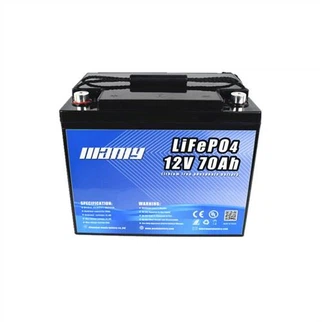
The reasons for the poor low-temperature performance of lithium-ion batteries can be explained from two perspectives: the material perspective and the electrochemical perspective. Let's talk about the explanation from the material perspective first.
For the electrolyte, the composition of the solvent is mainly some cyclic and chain esters, which have a common feature that the fluidity will become poor at low temperature, and some electrolytes will even partially solidify at -30℃~-40℃. As a result, the conduction of lithium ions in the electrolyte at low temperatures becomes slower, thus reducing the low-temperature charge and discharge performance of the battery. The melting points of common solvents used in electrolytes are listed in the following chart, the lower the melting point the more suitable the solvent is for use at low temperatures.
For positive and negative materials, the discharge process of lithium-ion batteries is the process of lithium ion deembedding from the negative electrode and embedded in the positive electrode. When the battery is discharged at low temperature, the impedance of lithium ion deembedding from the negative electrode and the impedance of embedding to the positive electrode will increase, thus increasing the resistance of the whole reaction.
This time careful friends may ask: what is the reason for the irreversible lithium precipitation caused by low-temperature charging? In contrast to the discharge process, the charging process is a lithium ion from the cathode and embedded in the negative process, at low temperatures, lithium ion low temperature embedded in the negative impedance will increase sharply, and so large that the lithium ion would rather be directly into a single precipitation on the surface of the negative electrode, rather than 100% embedded in the negative electrode inside. For low-temperature charging cathode lithium precipitation phenomenon, we can also do this qualitative understanding: for the cathode material, its "original state" is not embedded in the state of lithium ions, in low-temperature charging, the cathode has a very obvious tendency to maintain the original state, this trend makes lithium ions more difficult to embed.
After the introduction of the material perspective, I will give you some long knowledge of the principle, you guys please be patient to read on. Take discharge for example, the performance chapter has introduced to you, the low temperature discharge voltage will be significantly lower than the discharge voltage at room temperature, so what is the electrochemical principle that produces this phenomenon? The answer is the increase of "polarization" when the battery is discharged at low temperature. The polarization of the battery refers to the difference between the battery's charge and discharge process and its equilibrium state (when it is set aside). Daily charging and discharging can cause the polarization of a battery. One of the results of polarization is to produce a voltage different from the equilibrium state. For example, a battery with an equilibrium state voltage of 3.9V will be discharged at 0.5C at room temperature to about 3.8V instantly, and at 0.5C at low temperature to about 3.7V instantly, and the corresponding two pressure differences (3.9V-3.8V at room temperature and 3.9V-3.7V at low temperature) are the result of polarization. The result, and the name of the pressure difference is called the superpotential.
When a battery is charged and discharged from a shelved state, the change in voltage is called the superpotential, and the magnitude of the superpotential is a measure of the magnitude of polarization.
The polarization in a battery can be divided into two parts, the first part is called electrochemical polarization, which is mainly caused by the resistance of the electrochemical reaction. For lithium-ion batteries, the factors that cause electrochemical polarization include the resistance encountered by the conduction of lithium ions in the electrolyte, the resistance encountered by the embedding and de-embedding of lithium ions in the positive and negative electrodes, and the resistance of the collector fluid and the pole lug. When a lithium-ion battery is charged and discharged at low temperature, the conduction rate of lithium ions in the electrolyte decreases, and the resistance to embedding and de-embedding in the positive and negative electrodes increases, so the electrochemical polarization of charging and discharging at low temperature increases significantly compared with normal temperature.
Another cause of polarization is the concentration difference polarization. Take the low temperature discharge of lithium-ion battery as an example, it is a process in which lithium ions are disembedded from the negative electrode into the electrolyte and embedded from the electrolyte into the positive electrode. In this process, the electrolyte near the negative electrode has a higher concentration of lithium ions because of the continuous entry of lithium ions from the negative electrode, while the electrolyte near the surface of the positive electrode has a lower concentration of lithium ions. Because lithium ions are positively charged, an additional voltage needs to be applied continuously to maintain this lithium ion concentration difference, and this additional voltage is the result of the concentration difference polarization. As the temperature decreases, the diffusion of lithium ions in the electrolyte becomes slower, so this difference in concentration becomes larger, resulting in greater polarization. The schematic diagram of the concentration polarization during discharge is as follows.
The polarization in a battery consists of electrochemical polarization and concentration difference polarization.
To sum up: the reason for the poor performance of Li-ion battery at low temperature is that the ionic conductivity of electrolyte decreases at low temperature and the impedance of lithium ion disengagement and embedding at low temperature; from the electrochemical point of view, it is the increase of battery polarization at low temperature, and the polarization can be divided into two parts: electrochemical polarization and concentration polarization.