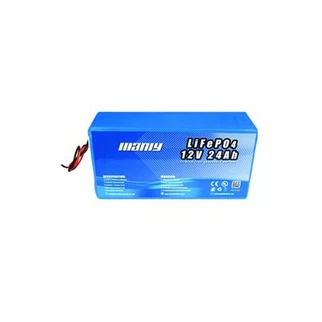
A LiFePO battery, also known as an LFP battery ("LFP" stands for "Lithium Iron Phosphate"), is a rechargeable battery, especially a Li-ion battery, that uses a graphitic carbon electrode with LiFePO as the cathode material, in which a metal current collector grid as the anode. The specific capacity of LiFePO is higher than the related lithium cobalt oxide (LiCoO) chemistry, but its energy density is slightly lower due to its low operating voltage. The main problem with LiFePO is its low electrical conductivity. Therefore, all LiFePO cathodes under consideration are actually LiFePO due to low cost, low toxicity, well-defined, long-term stability, etc. LiFePO is found in many roles in vehicle use, utility-scale stationary applications and backup power. History Lithium iron phosphate is a natural mineral of the olivine family (triterpene minerals). It is used as a battery electrode, originally published by John B. Goodenough's research group at the University of Texas in 1996 as a cathode material for rechargeable lithium batteries. It has achieved considerable market recognition. [The main obstacle to commercialization is its intrinsically low conductivity. This problem is overcome by reducing particle size, coating LiFePO particles with conductive materials, such as carbon nanotubes, or both. A group by another method includes materials that dope LFP with cations, such as aluminum, niobium, and zirconium. Products are now mass-produced and used in industrial products by major companies, including the Black and Decker brand. MIT has introduced a new coating that makes it easier for ions to move within a battery. The "Beltway Battery" employs a bypass system that allows lithium ions to enter and leave the electrodes at a rate large enough to fully charge the battery in under a minute. The scientists found that by coating particles of lithium iron phosphate in a glassy material called lithium pyrophosphate ions bypass the channel and move faster than other batteries. Rechargeable batteries store and release energy as charged atoms (ions) move between two electrodes (anode and cathode). Their charge and discharge rates are limited by the speed at which these ions move. This technology can reduce the weight and size of the battery. A small prototype battery has been developed that can be fully charged in 10 to 20 seconds, compared to 6 minutes for a standard battery. A negative electrode (anode, discharge) made of petroleum coke was used in early lithium-ion batteries; later types used natural or synthetic graphite.
This LiFePO4 battery uses a lithium-ion derived chemistry, which has many advantages and disadvantages compared to other lithium-ion battery chemistries. However, there are significant differences. Compared to other Li-ion methods, LFP chemistries have longer cycle life. [Like nickel-based rechargeable batteries (unlike other Li-ion batteries), LiFePO batteries have a very constant discharge voltage. The voltage remains close to 3.2 V during discharge until the battery is depleted. This allows the battery to deliver almost full power before it discharges, and it can greatly simplify or even eliminate the need for voltage regulation circuitry. Due to the rated 3.2 V output, four cells can be placed in series with a nominal voltage of 12.8 V. This is close to the nominal voltage of a six-cell chloric acid battery. In addition to the good safety features of LFP batteries, this makes LFP a good replacement for lead-acid batteries in automotive and solar applications, provided that the charging system does not damage LFP batteries due to overcharging voltages (over 3.6) during charging, each The voltage of the battery is DC, voltage compensation based on temperature, equalization attempt or continuous trickle charge. Before assembling the battery pack, the LFP cells must be at least balanced, and protection systems also need to be implemented to ensure that below 2.5V the cells will not be discharged or, in most cases, severely damaged. The use of phosphate avoids the cost and environmental concerns of cobalt, in particular the concern of cobalt entering the environment through improper handling and the potential for thermal runaway characteristics of cobalt-content rechargeable lithium batteries. LiFePO4 has a higher current or peak power rating than LiCoO. The energy density (energy/volume) of the new LFP cells is about 14% lower than that of the new LiCoO cells. Also, many brands of LFP, and the batteries in a given brand of LFP batteries, have a lower discharge rate than lead acid or LiCoO. Since the discharge rate is a percentage of the battery's capacity, if a low current battery must be used, then by using a larger battery (More Ampere Hours) Higher rates can be achieved. Even better, high current LFP batteries (which have a higher discharge rate than lead acid or LiCoO can use batteries of the same capacity). Lithium Iron Phosphate batteries have a slower rate of capacity loss (i.e. longer calendar life) compared to Li-ion battery chemistries such as LiCoO Cobalt or LiMn Manganese spinel Lithium-ion polymer batteries (LiPo batteries) or Li-ion Battery. ] After a year on the shelf, a LiFePO battery typically has roughly the same energy density as a LiCoO2 Li-Ion battery, because the energy density of LFP decreases more slowly. Compared to other lithium chemistries, LFP experienced slower degradation when stored in the fully charged state. This makes the LFP ideal for standby use. Safety An important advantage over other lithium-ion chemistries is thermal and chemical stability, which improves battery safety. LiFePO is an intrinsically safer cathode material and manganese spinel than LiCoO, with its negative resistance and increased thermal performance potentially facilitating thermal runaway by omitting cobalt. The Fe-P-bond ratio is stronger, so when abused, (short circuit, overheating, etc.) the oxygen atom is more difficult to remove. This stabilization of redox energy also contributes to fast ion transport. As lithium migrates out of the cathode cells in LiCoO, CoO undergoes nonlinear expansion, affecting the structural integrity of the cells. The structures in the fully lithiated and non-lithiated states of LiFePO are similar, indicating that LiFePO batteries are structurally more stable cells than LiCoO. There is no lithium residual unit in the cathode of a fully charged LiFePO cell, and about 50% remains in the cathode in a LiCoO battery. Oxygen in lithium iron phosphate is highly elastic during oxygen loss, which often leads to exothermic reactions in other lithium batteries. As a result, lithium iron phosphate batteries are more difficult to ignite in the event of mishandling (especially during charging), although any fully charged battery can only dissipate overcharge energy as heat. Therefore, it is still possible to cause battery failure through misuse. It is generally accepted that LiFePO batteries do not decompose at high temperatures. The difference between LFPs and LiPo batteries typically used in the hobby is especially notable. Specifications Battery Voltage Minimum Discharge Voltage = 2.5 V Operating Voltage = 3.0~3.3 V. Maximum Charging Voltage = 3.65 V. Volume Energy Density = 220 Wh/dm (790 kJ/dm 3) Gravity Energy Density > 90 Wh/kg (> 320 J/g) 100% DOD cycle life (cycles to 80% of original capacity) = 2,000-7,000 10% DOD cycle life (cycles to 80% of original capacity) > 10,000 [Sony Fortelion: With 100% mod 74% capacity after 8,000 cycles Cathode composition (weight) 90% C-LiFePO4, grade Phos-Dev-125% carbon EBN-10-10 (premium graphite) 5% polyvinylidene fluoride (PVDF) cell configuration carbon Coated Aluminum Current Collector 151.54cm Catholyte: Ethylene Carbonate-Dimethyl Carbonate (EC-DMC) 1-1 Lithium Perchlorate (LiClO 1M Anode: Graphite or Hard Carbon, Intercalated Metal Lithium Experimental Conditions: Room Temperature Voltage Limits : 2.0-3.65 V. Charging: up to C/1 rate up to 3.6 V, then constant voltage 3.6 V until I < C/24 According to the manufacturer BYD, the lithium iron phosphate battery of the electric vehicle e6 is charged at the fast charging station 15 Charges to 80% in minutes and 100% in 40 minutes.[Usage The higher discharge rate required for traffic acceleration, lighter weight and longer life make this battery type ideal for bicycles and electric vehicles .12V LiFePO 4 battery is also gaining popularity as a second (house) battery for caravans, car homes or boats.
A single "14500" (AA battery size) LFP battery is now used for some solar path lights instead of 1.2 V NiCd/NiMH. The LFP's higher (3.2 V) operating voltage can allow a single unit to drive an LED without the need for a boost circuit. The increased tolerance to moderate overcharge (compared to other Li cell types) means that LiFePO can be connected to photovoltaic cells without complex circuitry. A single LFP cell can also alleviate corrosion, condensation, and fouling issues associated with the cell holder and cell-to-cell contact—a poor connection that typically plagues outdoor systems that use multiple removable NiMH cells. More sophisticated LFP solar-charged passive infrared security lights are also emerging (2013). Since an AA size LFP battery has a capacity of only 600 mA h (whereas the light's bright LED may consume 60 mA), only 10 hours of runtime is expected. However - if only triggered occasionally - such a system can cope even in low sunlight charging conditions, as the lamp electronics ensure that after a dark "idle" current of less than 1mA. LiFePO4 power solar lights are significantly brighter than ordinary outdoor solar lights, and the overall performance is considered more reliable.