Today, most people are using solar lights in their homes because they are cost-effective and environmental-friendly. This famous solar lighting system is being adopted in both rural and urban areas. So, if you already have solar lights or aspiring to install them in your home, you’ll find this article useful.
We’ve discussed the five different types of batteries that can be used in solar lights. Each of them has pros and cons to help you identify the ones that will complement your preferences. Whether you’re looking for a battery type that will work best for your indoor or outdoor solar lights, this article will let you know everything you need.
What Types Of Batteries Are Used In Solar Lights?
1. NiCad (Nickel Cadmium) Batteries
NiCad is a rechargeable battery with many advantages over lead-acid but recently replaced by NiMH battery. It is the most popular choice since the 1990s because it comes in a similar size to alkaline batteries. Apart from being rechargeable, NiCad batteries also do not experience a voltage drop when their charge is low, which is a tremendous advantage over alkalines.
2. Lead-Acid Battery
It is one of the oldest rechargeable batteries still in existence, so, if you’re wondering whether it competes in modern times, yes, it does! Over the years, the Lead-acid battery has been able to retain a market share because newer battery chemistries are a bit too expensive.
Lead-acid is not a fast-charging battery, as its typical charging time ranges between 8 and 16 hours. Unlike most modern batteries, the lead-acid periodic charge is fully saturated, preventing sulfation and a possible recharge.
3. NiMH (Nickel Metal Hydride)
NiMH is a type of battery that replaces NiCad batteries by providing incremental improvements in capacity while reducing cycle life. When comparing Nickel Metal Hydride batteries to the standard NiCad, it has 30% more capacity and less susceptible to memory. Not to mention, NiMH requires few periodic exercise cycles.
This type is also the most popular brand used in solar lights and other purposes as well. Although this kind of battery was invented in the late ’60s, it became commercially available in the late ’80s. These days, NiMH is labeled “environmentally friendly” because it does not have toxic metals, making disposal easier
4. Li-Ion (Lithium-Ion) Battery
Li-ion is currently the fastest growing and most promising type of battery chemistry. It emerged in the early 90s and now has been gaining incredibly high customer acceptance. The energy density of Li-ion is high and typically twice that of a regular NiCad. It also has the potential for higher energy densities.
The battery requires less maintenance than other types of batteries and does not require scheduled and memory cycling to prolong its service life. Additionally, it suits applications like solar lights due to its less self-discharge that is less and half of the NiCad batteries. When disposed to a landfill, Lithium-ion batteries cause little harm.
Although this kind of battery has several positive attributes, it has its own drawbacks. If exposed to too high temperatures, it degrades very fast. The battery is quite fragile, and for safe operation, you will require a protection circuit. The aging of a Li-ion battery is a big concern due to its very short lifespan of two to three years. It is also costly compared to other battery chemistries.
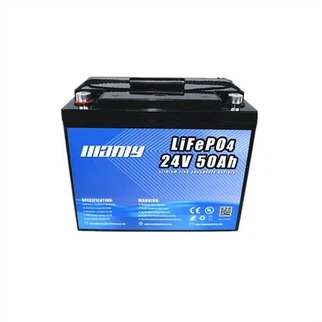
5. LiFePO4 (Lithium-Ion Phosphate) Battery
The battery is environmentally friendly, quick to charge, and has constant output power. During discharge, this battery’s voltage stays up to 3.2 Volts until it exhausts the cell, allowing it to deliver power effectively. However, LiFePO4 cells have a slower capacity rate than Lithium-ion batteries.