

The azimuth angle in photovoltaic power plant is the angle between the actual orientation of the solar cell array (i.e., the vertical plane of the array) and the due south direction, under the same tilt angle, different azimuths of the photovoltaic cell array plane receive different light time and receive different total radiation, usually the azimuth angle of the photovoltaic module array facing the longest time to receive light is regarded as the best azimuth angle.
Earth due to the rotation of the movement from west to east to produce the phenomenon of alternating daylight, the sun always rise in the east and set in the west; at the same time, the Earth has been rotating around the sun, the Earth and the sun in space at the closest point for the equator, that is, the northern and southern hemisphere boundary. Therefore, in the northern hemisphere photovoltaic modules facing south, while in the southern hemisphere, photovoltaic module installation facing north. Therefore, when the PV module faces due south in the northern hemisphere, the module receives the longest amount of light.
When designing PV power plants, the optimal azimuth is generally chosen to be due south, and this direction receives the longest amount of light. So the common ground power plant regardless of the terrain, after artificially corrected layout are due south, Yutian photovoltaic power plant azimuth is also due south, but in space and the adjacent county roads exist in the angle. Commercial and industrial distributed and household photovoltaic power plants can only be installed according to the actual azimuth and tilt angle of the house because they are installed on the roof, and if the roof is a concrete structure roof, the tilt angle and azimuth correction design can be made.
Comparison of the impact of azimuth on power generation is appropriate to use a single variable comparison, but the general plant station azimuth design are due south, so the design software can be used to simulate the data comparison. Taking a power station in the southern border area as an example, after the comparison of historical power generation and actual power generation measured by PV-system software, the accuracy rates from 2015-2019 are 99.3%, 94.9%, 98.2%, 92.6% and 95.1%, with an average accuracy rate of 96%, so the measurement results have certain reliability.
To simplify the data analysis, the geographic information and tilt angle of the plant station are input into the design software, and the annual cumulative solar radiation and annual power generation of the power station can be derived by changing the azimuth angle under different azimuth angles.
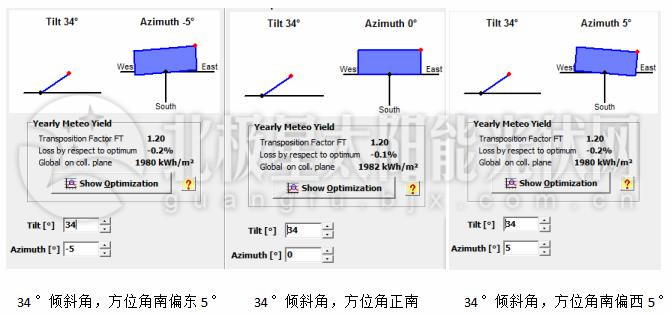
The data were collated to produce the following curves:

The comprehensive analysis of the above curves leads to the following three points.
① Under the same tilt angle, when the azimuth angle is 0°, the irradiation received by the component surface is the maximum, and as the absolute azimuth angle increases continuously, the irradiation received by the component surface decreases in numerical order, and the larger the azimuth angle is, the faster the irradiation decreases.
(ii) With the increase of dimension, the higher the latitude, the higher the azimuth angle increases by a certain value, the greater the decrease of its unit irradiance, that is, its slope increases in the curve; if the maximum radiation is to be obtained, the corresponding tilt angle increases accordingly.
(iii) The best azimuth angle for a PV plant in the northern hemisphere is due south, i.e. 0°, as derived from the graph.


