The tilt angle of a PV plant is the angle between the surface of the PV module and the surface water plane. When designing the power station, generally refer to the historical data of the accumulated annual radiation under different tilt angles, and choose the angle with the highest radiation as the best tilt angle design. Because the Earth has been rotating around the sun, the sun's direct point has been moving back and forth between the Earth's north and south tropic of return during a rotation cycle. So different tilt angle photovoltaic module surface plane to receive the total amount of radiation is not the same, we will receive to the total amount of annual radiation tilt angle is the largest called the best tilt angle.
In the actual selection of the best tilt angle process, but also choose to consider the geographical environment of the project construction site and the natural environment and other factors. Such as tilt angle on the impact of snow slippage; tilt angle changes on the module resistance to wind pressure, snow pressure impact; also need to consider these factors on the PV bracket selection and the impact of the foundation counterweight and angle too high caused by the front and rear row distance changes, increasing land costs.
Comparison of different tilt angle on the impact of power generation is appropriate to use a single variable comparison. But generally the same power station components tilt angle are the same angle and orientation, using different areas of the power station comparison, the impact factors and too much. Therefore, we consider using PV-System design software to demonstrate it. The meteorological data of the software comes from two meteorological databases, NASA and Meteonorm, and through actual measurement, the accuracy of its measurement is up to 99.3%, which has the reference.
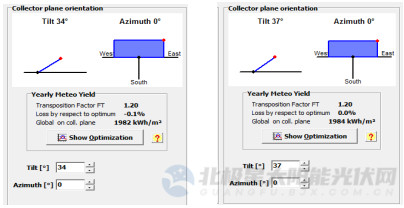
Take a power station in South China as an example, the actual installation tilt angle is 34°. However, when comparing the power generation under different tilt angles using the design software, it was found that under its geographical location, the module surface received the highest radiation and generated the highest power at a tilt angle of 37°. The actual installation angle power generation is 0.13% lower than the measured optimal angle annual power generation, as follows:
The total annual radiation and power generation at different tilt angles are as follows:
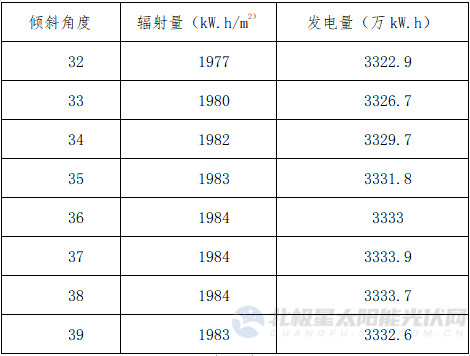
The analysis of the above data allows us to make the following observations.
(1) The optimal tilt angle is related to the local geographical latitude. Taking the equator as the reference point, when the geographical latitude gradually increases toward the earth's poles, the corresponding optimal tilt angle number also gradually increases.
(2) tilt angle from the horizontal (0 °) to the best tilt angle increases, its surface received radiation correspondingly increased, reaching the best tilt angle received the maximum amount of radiation; as the tilt angle continues to increase its surface received radiation and began to reduce, corresponding to gradually reduce the amount of power generation.
(3) tilt angle in the best tilt angle of ± 5 ° range, the impact of radiation on power generation is relatively limited. (Source: Polaris Solar PV Network Author: Xinjiang Wind Energy Zhou Zhixiong Zhang Mao)