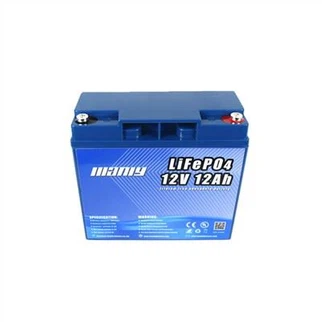
Lithium iron phosphate battery: refers to a lithium ion battery using lithium iron phosphate as the positive electrode material. Its characteristics are that it does not contain precious elements such as cobalt, the price of raw materials is low, and phosphorus and iron are abundant in the earth's resources, so there will be no problem of supply. It has moderate operating voltage (3.2V), large capacitance per unit weight (170mAh/g), high discharge power, fast charging, long cycle life, and high stability in high temperature and high thermal environments.
Advantages of lithium iron phosphate batteries
Compared with the more common lithium cobalt oxide and lithium manganate batteries currently on the market, lithium iron phosphate batteries have at least the following five advantages: higher safety, longer service life, and no heavy metals and rare metals (raw materials). low cost), supports fast charging, and has a wide operating temperature range.
Disadvantages of lithium iron phosphate batteries
Lithium iron phosphate has some performance defects, such as low tap density and compaction density, resulting in low energy density of lithium-ion batteries; high material preparation costs and battery manufacturing costs, low battery yield and poor consistency ; Poor product consistency; Intellectual property issues.
Comparative analysis of lithium titanate battery and lithium iron phosphate
Analysis and comparison of lithium titanate battery and lithium iron phosphate
In the field of pure electric vehicles, most of the batteries are lithium iron phosphate or ternary lithium, and the core competitiveness of Yinlong Bus, which Gree intends to acquire recently, is a new lithium titanate battery.
Domestic automobile manufacturers use more ternary lithium batteries and lithium iron phosphate batteries. Lithium titanate has not yet been scaled. And the price of lithium titanate battery is high (high production cost, high humidity control requirements), about 9 yuan per watt-hour, and the gap between lithium iron phosphate battery and ternary lithium battery is about 2 yuan per watt-hour.
Compared with lithium iron phosphate, lithium titanate battery is better or worse? This also starts with the performance of the two batteries. As we all know, the performance of lithium batteries is mainly determined by the positive electrode, negative electrode, electrolyte and separator. The positive and negative electrode materials have an important impact on the key indicators of the battery, such as capacity, energy density, cycle life, safety, rate performance, and cost.
The lithium titanate battery breaks the traditional battery technology route of using graphene as the negative electrode, and uses lithium titanate as the negative electrode material, which makes it an outlier in the eyes of its peers. But it is the characteristics of lithium titanate itself that make the battery of this material have remarkable characteristics.
Comparative analysis of lithium titanate battery and lithium iron phosphate
Taking lithium iron phosphate-graphene and ternary-lithium titanate lithium batteries as examples, in terms of energy density alone, lithium titanate batteries are at a disadvantage. The Northeast Securities Research Report pointed out that the actual specific energy of lithium iron phosphate batteries is 100-120Wh/kg, of which the nickel-cobalt-aluminum ternary battery used by Tesla reaches 252Wh/kg, while the Yinlong lithium titanate battery is only 90Wh/kg. kg, which is only half of that of some graphite-based anode material batteries.
In terms of cost, lithium titanate batteries have no advantages. At present, the raw materials of Yinlong lithium titanate battery include titanium hydroxide and lithium hydroxide, the price of which is higher than that of graphite anode materials. According to the survey results of China Battery Network, the current cost of lithium iron phosphate and ternary battery is 1100 yuan/kwh-1200 yuan/kwh, while the cost of lithium titanate battery is about 2-3 times of ternary battery.
The energy density is twice as low and the cost is 2-3 times higher. How can lithium titanate batteries participate in market competition? Obviously, it is its own unique advantages that moved some people in the industry.
The safety of lithium titanate battery is outstanding
When lithium titanate is used as the negative electrode material, the potential platform is as high as 1.55V, which is more than 1V higher than that of the traditional graphite negative electrode material. Although some energy density is lost, it also means that the battery is safer. Technical expert Lu Blu-ray once said that the demand for the negative electrode voltage is relatively low when the battery is fast charged, but if it is too low, the lithium battery is prone to precipitation of very active metal lithium. This lithium ion is not only conductive, but also reacts with the electrolyte, and then It releases heat, generates flammable gas, and causes fire. The lithium titanate avoids the situation where the negative electrode voltage is 0 because of the higher 1V voltage, which indirectly avoids the precipitation of lithium ions, thereby ensuring the safety of the battery.
Because the lithium titanate battery can be used safely in both high temperature and low temperature environments, it also reflects its important advantages of wide temperature resistance (especially low temperature resistance). At present, the safe working temperature range of Yinlong lithium titanate battery is between -50 degrees and 65 degrees, while the energy of ordinary graphite anode batteries begins to decay when the temperature is lower than -20 degrees, and the charging capacity at -30 degrees is only At 14% of the total charging capacity, it simply cannot work properly in severe cold weather.
Comparative analysis of lithium titanate battery and lithium iron phosphate
In addition, because the lithium titanate battery has only a 1% volume change even if it is overcharged, it is called a zero-strain material, which makes it have an extremely long life. Wei Yincang, chairman of Yinlong, once said that the life of Yinlong lithium titanate battery can reach 30 years, which is comparable to that of a car, while the average life of ordinary graphite anode material battery is only 3-4 years. From the perspective of the whole life cycle, the cost of lithium titanate battery is lower.
The last advantage of lithium titanate is its strong fast charge and discharge capability and high charge rate. At present, the charging rate of Yinlong lithium titanate battery is 10C or even 20C, while the charging rate of ordinary graphite anode material is only 2C-4C.
Based on these technical characteristics of lithium titanate batteries, industry insiders believe that they meet the needs of new energy buses and large-scale energy storage equipment. Take the bus as an example, the mileage of a single trip generally does not exceed 40 kilometers, and it takes at least a few minutes between each terminal station and waiting until the next departure time. At this time, the disadvantage of low energy density of lithium titanate battery will not affect the use of passenger cars, but reflects the benefits of fast battery charging. As a public transportation, buses have put forward higher requirements on the safety and durability of batteries.