

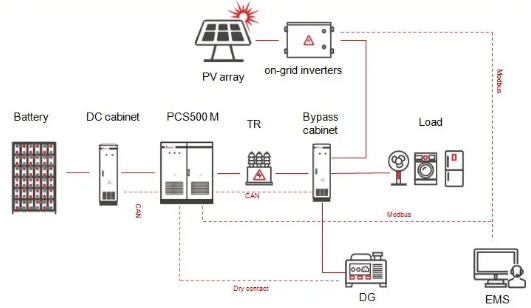
Energy storage converter, also known as bi-directional energy storage inverter, PCS (Power Conversion System), is used in grid-connected energy storage and micro-grid energy storage and other AC coupling energy storage systems, connecting the battery bank and the grid (or load), is a device to achieve bi-directional conversion of electrical energy. It can reverse the DC power from the battery into AC power and transmit it to the grid or to the AC load; it can also rectify the AC power from the grid into DC power and charge the battery.

Energy storage converter (PCS) consists of power, control, protection, monitoring and other software and hardware electric components. Single-phase PCS is usually composed of two-way DC-DC boost device and DC/AC AC/DC converter, the DC side is usually 48Vdc, the AC side 220Vac. three-phase PCS is divided into two types, small power three-phase PCS is composed of two-way DC-DC boost device and DC/AC AC/DC converter, high-power three-phase PCS is composed of DC/AC AC/DC converter. AC-DC converter first stage device. Energy storage converters are divided into three types: high frequency isolation, industrial frequency isolation and no isolation. single-phase and low-power three-phase PCS below 20kW generally use high-frequency isolation, 50kW to 250kW, generally use industrial frequency isolation, and above 500kW generally use no isolation.
Important technical parameters of energy storage converter: Due to different applications, the functions and technical parameters of energy storage converter vary greatly, and attention should be paid to system voltage, power factor, peak power, conversion efficiency, switching time and so on when selecting, and the selection of these parameters has a large impact on the function of energy storage system.
System voltage
It is the voltage of the battery bank, the input voltage of the energy storage inverter. Energy storage inverters of different technologies, the system voltage varies greatly, single-phase two-stage structure of the energy storage converter in about 50V, three-phase two-stage structure of the energy storage converter between 150V-550V. Three-phase energy storage inverters with IFT isolation transformers are between 500V-800V, and three-phase energy storage inverters without IFT isolation transformers are between 600V-900V.
Power Factor
When the energy storage inverter is operating normally, the power factor should be greater than 0.99. When the system is involved in power factor regulation, the power factor range should be as wide as possible.
Switching time
There are two kinds of switching time for energy storage inverter, one is charging and discharging switching, large energy storage countercurrent should be able to quickly switch the operation state, usually required between 90% rated power grid-connected charging state and 90% rated power grid-connected discharging state, the switching time is not more than 200ms, the second is applied to switch between grid-connected mode and off-grid mode, the switching time is not more than 100ms.
The energy storage converter mainly has two working modes: on-grid and off-grid. Grid-connected mode, to achieve two-way energy conversion between the battery bank and the grid. It has the characteristics of grid-connected inverter, such as anti-islanding, automatic tracking of grid voltage phase and frequency, low-voltage ride-through, etc. According to the requirements of grid dispatch or local control, PCS converts AC power from grid into DC power to charge the battery bank during grid load low period, with battery charging and discharging management function; during grid load peak period, it reverses DC power from battery bank into AC power to feed back to the public grid; during grid load peak period, it converts DC power from battery bank into AC power to charge the battery bank. When the power quality is not good, it feeds or absorbs active power to the grid and provides reactive power compensation. Off-grid mode, also known as off-grid operation, means that the PCS can be disconnected from the main grid according to the actual needs and under the condition of meeting the set requirements, providing AC power to the local load to meet the power quality requirements of the grid.
Summary
In a micro-grid system composed of multiple energy sources, the energy storage converter is the core equipment, because renewable energy sources such as photovoltaic and wind power are volatile, and the load is also volatile, and the fuel generator can only generate power, not absorb it. If there are only PV, wind, and fuel generators in the system, the system operation may be unbalanced, and when the power of renewable energy is greater than the load power, the system may fail, so it is difficult for the PV grid-connected inverter to run in parallel with the fuel generator, and the energy storage converter can absorb energy and also emit energy, and the response speed is fast, which plays a balancing role in the system.


