1 Background
Lithium iron phosphate battery (lifepo4 battery) has the characteristics of good safety, high specific energy and specific power, and long cycle life, and is widely used in backup power supply, large-scale energy storage and electric vehicles. This paper takes the battery returned from electric vehicle as the research object, obtains data through performance test experiments, and then summarizes the characteristics of the battery, so as to obtain a comprehensive performance evaluation of this type of battery, which is used as a data support for the battery’s cascade utilization in large-scale energy storage systems .
2 Composition, structure and working principle
Lithium iron phosphate battery (lifepo4 battery) is generally composed of positive electrode, negative electrode, separator, electrolyte, shell and other auxiliary accessories. The positive electrode active material is olivine-type lithium iron phosphate (LiFePO4), which can be used only after carbon coating, doping and other modifications. The negative electrode active materials are graphite-like materials such as natural graphite and artificial graphite, as well as carbon materials such as hard carbon and soft carbon, which also need proper treatment before they can be used. The diaphragm is one or two materials of polyethylene (PE) and polypropylene (PP). It is often used as a single-layer or multi-layer composite film. There is also a method of adding inorganic ceramic membrane reinforcement treatment to the surface of the membrane. Improve battery safety to a certain extent.
The electrolyte is a lithium salt solution with a chain or cyclic carbonate as a solvent, and special additives are added to it. The outer casing is a container that accommodates other components of the battery. Most of them are high-strength, corrosion-resistant stainless steel, aluminum alloy, special plastics and other materials. There are also batteries with aluminum-plastic composite film as the outer casing. In actual use, a high-strength casing needs to be added for protection. . In addition, there are conductive agents that increase the conductivity of positive and negative electrodes, binders to fix active materials, copper foils and aluminum foils that support powder materials and current collectors, and connecting sheets that connect the inside and outside of the battery and conduct electricity. Ancillary accessories such as poles and poles.
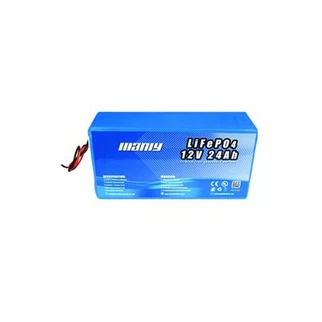
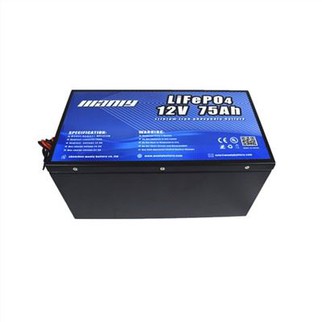
From the perspective of appearance, the lithium iron phosphate battery (lifepo4 battery) produced by manly battery has cylindrical, prismatic, square, irregular shapes and other types, which appear according to the difference in use requirements. The internal structure of a typical LiFePO4 battery is shown in Figure 1. On the left is LiFePO4 with olivine structure as the positive electrode of the battery, which is connected to the positive pole of the battery by aluminum foil, and the middle is a polymer separator, which separates the positive electrode from the negative electrode, but the lithium ion Li+ can pass through but the electron e cannot pass through, the right side is the negative electrode of the battery , connected with the negative pole of the battery by copper foil. Between the upper and lower ends of the battery is the electrolyte of the battery, and the battery is hermetically sealed by a metal casing.
When LiFePO4 battery is charged, the lithium ion Lit in the positive electrode migrates to the negative electrode through the polymer separator; during the discharge process, the lithium ion Lit in the negative electrode migrates to the positive electrode through the separator. Lithium-ion batteries are named after lithium ions migrate back and forth during charging and discharging.
When the lithium iron phosphate battery is charged and discharged, the chemical reaction that occurs is reversible. The overall reaction is as follows:
Discharge FePO4+LiC6→C6+LiFePO4;
Charge C6+LiFePO4→FePO4+LiC6;