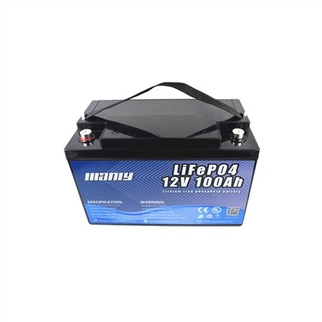
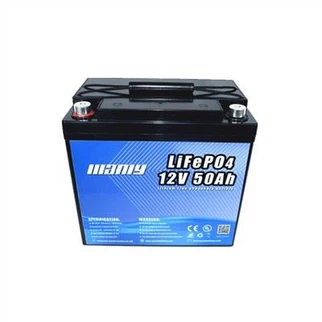
Lithium iron phosphate battery and lithium manganese acid, lithium cobalt acid, ternary lithium battery is a branch of lithium ion battery, its performance is mainly suitable for power applications, then called lithium iron phosphate power battery, also known as lithium iron battery. Therefore, the advantage of lithium iron phosphate battery mainly refers to its comparison with other batteries in power application. In this sense, it will mainly compare its relative advantages with ternary lithium battery and lead-acid battery.
1. Advantages of high temperature resistance compared with ternary lithium batteries. Lithium iron phosphate batteries have better high temperature performance, can withstand high temperatures of 350°C to 500°C, while lithium manganese/lithium cobalt acid is usually only about 200°C, modified terpolymer lithium battery materials will roughly decompose at 200°C.
The "elder" of the three -- the absolute longevity advantage. Lithium iron phosphate batteries have a longer cycle life than lead-acid batteries and ternary lithium batteries. The "long life" of lead-acid battery is only about 300 times, up to 500 times; Ternary lithium battery can be up to 2000 times in theory, the actual application of 1000 times or so the capacity will decay to 60%; The real life of lithium iron phosphate battery is 2000 times, at this time there is still 95% capacity, and its conceptual cycle life is more than 3000 times.
Three, compared with lead-acid battery has many advantages:
1. Large capacity. Monomer can be made into 5Ah~1000 Ah (1 Ah = 1000m Ah), and lead acid battery 2V monomer is usually 100Ah~150 Ah, the change range is small.
2. Light weight. A lithium-iron phosphate battery of the same capacity is 2/3 the volume and 1/3 the weight of a lead-acid battery.
3. Fast charging capacity is strong. The starting current of lithium iron phosphate battery can be up to 2C, realizing high rate charging; The current of lead-acid batteries is generally required to be between 0.1c and 0.2c, which cannot achieve fast charging performance.
4. Environmental protection. Lead-acid batteries contain a large amount of heavy metal -- lead, resulting in waste liquid, while lithium iron phosphate batteries do not contain any heavy metal, and are pollution-free in production and use.
5. High cost performance. Although lead-acid batteries are cheaper to purchase than lithium iron phosphate batteries due to their cheaper materials, they are less economical than lithium iron phosphate batteries in terms of service life and maintenance. The practical application results show that the cost performance of a lithium iron phosphate battery is more than 4 times that of lead acid battery.
Lithium iron phosphate battery application scope is mainly manifested in the direction of power, but also, in theory, can be extended to more areas, it is by the comparison of the various advantages, if in such aspects as energy density and the discharge ratio do ascend, traditional into other types of lithium-ion battery application field is also possible.