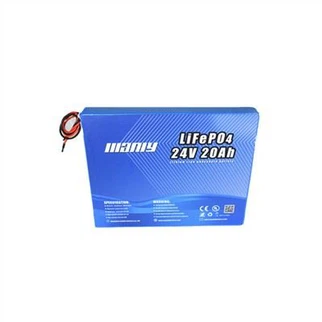
The full name of lithium iron phosphate battery is lithium iron phosphate battery, because its performance is particularly suitable for power applications, so the word power is added to its name, that is, lithium iron phosphate power lithium battery. Others call it Lithium-Iron (Life) Power Lithium Batteries.
Lithium iron phosphate battery refers to a lithium ion battery with lithium iron phosphate as the positive electrode material. Lithium-ion battery cathode materials mainly include lithium cobalt acid, lithium manganese acid, lithium nickel acid, three materials, lithium iron phosphate, etc. Lithium cobalt oxide is the anode material for most lithium-ion batteries.
In the metal market, cobalt (Co) is the most expensive with few stocks, nickel (Ni) and manganese (Mn) are cheaper, and iron (Fe) is the cheapest. Prices for cathode materials are also in line with those of these metals. Therefore, Li-ion batteries made of LiFePO4 anode material should be the cheapest. Another feature is that it does not pollute the environment.
The requirements of rechargeable batteries are: high capacity, high output voltage, good charge-discharge cycle performance, stable output voltage, high-current charge-discharge, electrochemical stability, safe use (not charging, discharging and improper short-circuit operations, such as burning or Explosion), wide operating temperature range, non-toxic or less toxic, no pollution to the environment.
The anode of lithium iron phosphate lithium ion battery is good for these performance requirements, especially in large discharge rate discharge (5~10c discharge), the discharge voltage is stable, safe, will not burn, will not explode, and life (cycle) , No pollution to the environment, it is the best, is currently the best battery high current output power.
Structure and working principle
LiFePO4 is the positive electrode of the battery, which is connected to the positive electrode of the battery by aluminum foil. In the middle is a polymer film that separates the positive and negative electrodes, but lithium ions Li can pass through, while electrons e- cannot. On the right is the negative electrode of the battery, which is made of carbon (graphite) and is connected to the negative electrode of the battery through a copper foil. Between the upper and lower ends of the battery is the battery's electrolyte, which is enclosed in a metal casing.
When the LiFePO4 battery is charged, the positive lithium ions Li migrate to the negative electrode through the polymer film. During the discharge process, lithium ions in the negative electrode migrate to the positive electrode through the separator. Lithium-ion batteries get their name from the movement of lithium ions back and forth between charge and discharge