

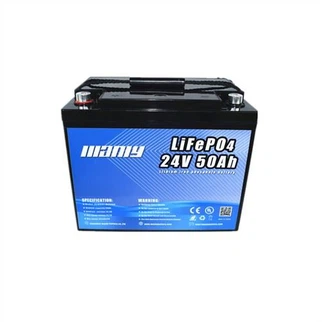
1. Lithium iron phosphate battery (一) Introduction Lithium iron phosphate battery refers to a lithium-ion battery that uses lithium iron phosphate as a positive electrode material. The cathode materials of lithium-ion batteries mainly include lithium cobalt oxide, lithium manganate, lithium nickelate, ternary materials, and lithium iron phosphate. Among them, lithium cobalt oxide is currently the cathode material used in most lithium-ion batteries. (二) advantages 1. The lithium iron phosphate battery has a long life, with a cycle life of more than 2000 times. Under the same conditions, lithium iron phosphate batteries can be used for 7 to 8 years. 2. Safe to use. The lithium iron phosphate battery has undergone strict safety tests and will not explode even in a traffic accident. 3. Fast charging. Using a dedicated charger, the battery can be fully charged with a 1.5C charge in 40 minutes. 4. The lithium iron phosphate battery is resistant to high temperatures, and the hot air value of the lithium iron phosphate battery can reach 350 to 500 degrees Celsius. 5. The lithium iron phosphate battery has a large capacity. 6. The lithium iron phosphate battery has no memory effect. 7. Lithium iron phosphate battery is environmentally friendly, non-toxic, non-polluting, has a wide range of raw materials, and is cheap. (三) Disadvantages 1. The tap density of the positive electrode of the lithium iron phosphate battery is small, and the density is generally about 0.8 to 1.3. Big size. 2. Poor conductivity, slow diffusion of lithium ions, and low actual specific capacity during high charge and discharge. 3. The low-temperature performance of lithium iron phosphate battery is poor. 4. The life of a single battery of lithium iron phosphate battery is long, about 2000 times, but the life of a lithium iron phosphate battery pack is short, generally about 500 times. (4) Application areas Large-scale electric vehicles: buses, electric vehicles, tourist attractions, and hybrid vehicles, etc.; Light electric vehicles: electric bicycles, golf carts, small flat battery carts, forklifts, cleaning vehicles, electric wheelchairs, etc.; Electric tools: electric drill, electric saw, lawnmower, etc.; Remote control cars, boats, airplanes, and other toys; Energy storage equipment for solar and wind power generation; UPS and emergency lights, warning lights, and miner's lamps (the best safety); Replace the 3V disposable lithium battery and 9V nickel-cadmium or nickel-metal hydride rechargeable battery in the camera (the same size); Small medical equipment and portable equipment, etc. 2. Lithium battery (一) Introduction Lithium batteries are a type of batteries that use lithium metal or lithium alloy as the negative electrode material and use a non-aqueous electrolyte solution. Due to the very active chemical properties of lithium metal, the processing, storage, and use of lithium metal have very high environmental requirements. Therefore, lithium batteries have not been used for a long time. With the development of science and technology, lithium batteries have now become mainstream. (二) advantages 1. The energy is relatively high. With high storage energy density, it has reached 460-600Wh/kg, which is about 6-7 times that of lead-acid batteries; 2. The service life is long, and the service life can reach more than 6 years. The battery with lithium iron phosphate as the positive electrode is charged and discharged at 1C (100% DOD), and has a record of 10,000 times of use; 3. The rated voltage is high (the single working voltage is 3.7V or 3.2V), which is approximately equal to the series voltage of three nickel-cadmium or nickel-hydrogen rechargeable batteries, which is convenient to form a battery power pack; lithium batteries can pass a new type of lithium The technology of battery voltage regulator adjusts the voltage to 3.0V to suit the use of small appliances; 4. With high power tolerance, the lithium iron phosphate lithium-ion battery used in electric vehicles can reach 15-30C charge and discharge capacity, which is convenient for high-intensity start-up acceleration; 5. The self-discharge rate is very low, which is one of the most prominent advantages of the battery. Generally, it can be less than 1% per month, which is less than 1/20 of the nickel-hydrogen battery; 6. Lightweight, the weight is about 1/6-1/5 of the lead-acid product under the same volume; 7. High and low-temperature adaptability is strong, it can be used in an environment of -20℃-60℃, after the process treatment, it can be used in an environment of -45℃; 8. Green and environmental protection, no matter it is produced, used or scrapped, it does not contain or produce any toxic and harmful heavy metal elements and substances such as lead, mercury, cadmium, etc. 9. Production basically does not consume water, which is very beneficial to our water shortage. Specific energy refers to the energy per unit weight or unit volume. Specific energy is expressed in Wh/kg or Wh/L. Wh is the unit of energy, W is the watt, h is hour; kg is kilogram (weight unit), L is the liter (volume unit). (三) Disadvantages 1. All lithium primary batteries have poor safety and may explode. 2. The lithium-ion battery of lithium cobalt oxide cannot be discharged at a high current, is expensive, and has poor safety. 3. Lithium-ion batteries need to protect the circuit to prevent the battery from being overcharged and over-discharged. 4. High production requirements and high cost. 5. The use conditions are limited, and the use of high and low temperatures is dangerous. (四) Application areas 1. Traffic power supply 2. Electric energy storage power supply 3. Power for mobile communication 4. New energy storage power electricity 5. Aerospace military power supply Three, the difference between lithium iron phosphate battery and lithium battery Lithium iron phosphate batteries are not the same as lithium batteries. 1. Lithium iron phosphate batteries are used to make lithium-ion secondary batteries. The main direction is now power batteries, which have great advantages over NI-H and Ni-Cd batteries. 2. Lithium battery is a type of battery that uses lithium metal or lithium alloy as the cathode material and uses a non-aqueous electrolyte solution. The chemical properties of lithium metal are very active, which makes the processing, storage, and use of lithium metal very demanding on the environment. 3. Lithium iron phosphate puncture will not cause fire or explosion, and lithium battery will. 4. Lithium iron phosphate will not ignite or explode if overcharged to 100%; the lithium battery will gas out and swell when it reaches the specified value
Jan 10, 2021
What is a lithium iron phosphate battery? What is the difference between a lithium battery and a lithium iron phosphate battery?
You Might Also Like




Send Message