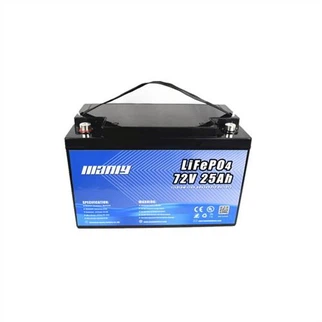
The full name of lithium iron phosphate battery should be lithium iron phosphate lithium ion battery, this name is too long, referred to as lithium iron phosphate battery. Because its performance is particularly suitable for power applications, the word "power" is added to the name, that is, lithium iron phosphate power battery. Some people also call it "lithium iron (LiFe) power battery. After 2002, lithium iron phosphate power battery was launched.
The interior of a lithium-ion battery is mainly composed of a positive electrode, a negative electrode, an electrolyte and a separator. Positive, negative and electrolyte. Different materials and processes make the battery have different performance and have different names. At present, the cathode materials of lithium-ion batteries on the market are mainly lithium cobalt oxide (LiCo02), and there are also a few lithium-ion batteries that use lithium manganese oxide (LiMn204) and lithium nickel oxide (LiNi02) as cathode materials.
Lithium-ion batteries with the latter two cathode materials are generally referred to as "lithium-manganese batteries" and "lithium-nickel batteries". The newly developed lithium iron phosphate power battery is a lithium ion battery using lithium iron phosphate (LiFeP04) material as the positive electrode of the battery, which is a new member of the lithium ion battery family.
At present, the main cathode materials used for lithium-ion batteries are: LiCoO2, LiMn2O4, LiNiO2 and LiFeP04. Among these metal elements composing the positive electrode material of batteries, cobalt (Co) is the most expensive and has little storage capacity, nickel (Ni) and manganese (Mn) are relatively cheap, and iron (Fe) is the cheapest. The prices of cathode materials are also in line with the prices of these metals. Therefore, the lithium-ion battery made of LiFeP04 cathode material should be the cheapest. Another feature of it is that it does not pollute the environment.