In a lot of renewable energy, solar energy with its green, environmental protection, inexhaustible, inexhaustible, and other characteristics become the most potent form of energy, has a huge market prospect. China has very rich solar energy resources, the development of the photovoltaic industry is of great significance to the improvement of electricity consumption in underdeveloped areas and remote areas. However, the photovoltaic power generation has discontinuity and instability, and the power generation performance changes with the change of the external environment. Therefore, the high-performance storage link is very important to the development of the photovoltaic industry.
At present, most photovoltaic systems use lead-acid batteries as energy storage devices. Compared with lead-acid batteries, lithium-iron-phosphate batteries have the advantages of high specific energy, high energy storage efficiency, long cycle life, and low operating cost. In this paper, the conventional performance and energy storage characteristics of lead-acid batteries and lithium-iron-phosphate batteries are compared. Based on the analysis of the feasibility of using the lithium-iron-phosphate battery as the photovoltaic system energy storage device, the corresponding photovoltaic power generation energy storage system is designed.
1. Basic requirements of solar photovoltaic power generation system for energy storage
Solar power generation system has a high cost, low conversion efficiency, and strong change with the environment, so it has high requirements for energy storage. The service life of a solar photovoltaic power generation system is generally 20 years, and the supporting energy storage link is required to have the characteristics of long service life, stable performance, high energy efficiency, and strong ability to adapt to the environment.
At present, the energy storage technology used in photovoltaic power generation systems mainly includes electrochemical cells, flywheels, superconducting coils, and so on. Comparatively speaking, flywheel energy storage and superconducting energy storage have incomparable advantages over the chemical battery in performance and will become the inevitable trend of the development of energy storage devices. However, at the present stage, due to the reasons of technology and price, the chemical battery is still the main way of solar photovoltaic energy storage.
Using the chemical battery as the energy storage link of the photovoltaic power source is to directly convert the energy released by the REDOX in the chemical reaction into direct current energy for the use of the load.
2, Performance analysis of lithium-iron-phosphate battery
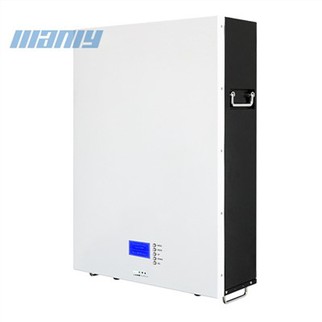
Lithium-iron phosphate battery is a new type of secondary power source developed in recent years. It has the characteristics of large input and output power, wide operating temperature range, no memory effect, maintenance-free, 2000 charge-discharge service life, safety, and green environmental protection, and is becoming the leading role of chemical batteries.
The main material of lithium iron phosphate battery is carbon, the main material of lithium iron phosphate is LiFePO4, and the electrolyte uses LIPF6 organic solvent. The basic principle of charge and discharge is the embedding and stripping of lithium ions between positive and negative electrodes.
The voltage platform of a lithium-iron-phosphate battery is 3.2V, and the specific energy is more than twice that of a lead-acid battery, while the specific energy of volume is 4-5 times that of the lead-acid battery. If a lithium-iron-phosphate battery is used instead of a lead-acid battery for a photovoltaic power generation system, the space occupied by the battery can be greatly reduced and the maintenance workload can be reduced.
3, Development and design of lithium iron phosphate battery energy storage system
The basic architecture of the energy storage system with the photovoltaic power station is shown in Figure 1. The photovoltaic module array converts light energy into electric energy by using the photovoltaic effect of the solar panel, charges the iron-lithium battery through the photovoltaic controller, and then directly supplies power to the electrical equipment through the inverter or introduces the electric energy into the grid through the grid-connected inverter. The battery management system (BMS in figure 1 have the effect of managing the battery, first of all, the battery pack to the acquisition of data, and according to the collected data of battery running state diagnosis, overvoltage, Undervoltage, by monitoring the battery temperature, overcharge, discharge, over-current, remaining capacity (SOC) and the effect of monomer battery state of health (SOH).
4, Conclusion
The rapid development of solar photovoltaic power generation systems puts forward higher requirements for energy storage systems. Lead-acid battery due to its own high-temperature resistance, overcharge and discharge resistance, maintenance workload, and short life, and other defects, hinder the further development of photovoltaic power generation. Lithium iron phosphate battery is suitable for new energy storage power supply due to its high energy storage efficiency, long life, and good charge-discharge performance. Based on the analysis of the feasibility of using lithium-iron-phosphate batteries as photovoltaic energy storage devices, a photovoltaic energy storage system based on lithium-iron-phosphate batteries is designed in this paper. The research shows that the system has high energy efficiency, the long service life of charge and discharge, stable and reliable operation, and good application prospect.