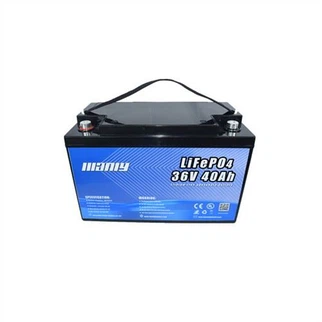
Display of lithium iron phosphate battery under different temperature conditions:
The second thing I want to introduce to you is that lithium iron phosphate batteries will have different discharge phenomena at different adjusted temperatures. We will set the temperature to minus 20 degrees to above 40 degrees. At this time, everyone will find iron phosphate. When the lithium-ion battery is at 23℃, the power generation capacity can reach 100%, while the discharge capacity at 0℃ will be 78%, which means that the discharge rate of other iron-lithium-ion batteries under different temperature conditions is are not the same, so when you estimate the lithium iron phosphate battery, you must keep it in a certain temperature range. In this case, the estimated result is better, but it is only under extreme temperature conditions. In terms of performance, lithium iron phosphate batteries are true and have a very long life, which can reach more than 570 discharge cycles.
The experiment of putting lithium iron phosphate battery to zero voltage:
Put the lithium iron phosphate battery in a zero-voltage experiment, and you will find that after the battery is fully charged in 3 days, the battery continues to discharge in such an environment, and it is found that its capacity will change very little. It shows that its capacity recovery is very good.
Finally, there are patent disputes in the production of lithium iron phosphate batteries abroad, which is one reason why foreign electric vehicles generally use lithium-ion batteries with ternary cathode materials.
The lifespan of lithium iron phosphate batteries may not be 4-5 times longer than that of lead-acid batteries. For lead-acid batteries with relatively high technical content, there is no problem with the lifespan reaching 5 years. Because of the structural collapse of the negative electrode material graphite, lithium-ion batteries will be scrapped even if they are not used for five years.
The cycle life of a long-life lead-acid battery is about 300 times, and the highest is 500 times. The lithium iron phosphate power lithium battery has a cycle life of more than 2000 times, and it can be used 2000 times with standard charging (5-hour rate). Lead-acid batteries of the same quality are new half a year, half a year old, and half a year for maintenance, at most 1 to 1.5 years, while lithium iron phosphate batteries used under the same conditions will have a theoretical life of 7 to 8 years. Comprehensive considerations, the performance-price ratio is theoretically more than 4 times that of lead-acid batteries. High current discharge can quickly charge and discharge high current 2C. With a dedicated charger, the battery can be fully charged within 40 minutes of 1.5C charging. The starting current can reach 2C, but lead-acid batteries have no such performance.
Lithium iron phosphate battery pack is generally available for about 8 years; but if used in the south. The life of a lithium iron phosphate battery is longer than 8 years. The theoretical life of the lithium iron phosphate battery pack also exceeds 2000 charge-discharge cycles, even if it is charged once a day, it can last for more than five years. Generally speaking, the daily household charge is three days, and it can be used for about eight years. However, due to the poor low-temperature performance of lithium iron phosphate batteries, the life of lithium iron phosphate batteries will be relatively longer in the southern region.

(12V LiFePo4 Solar Battery 100Ah)
MANLY Battery Company, a professional manufacturer of lithium iron phosphate batteries, provides customized services for multi-series parallel lithium iron phosphate batteries/lithium iron phosphate power batteries. The products are widely used in electric bicycles, golf carts, electric wheelchairs, electric tools, electric toys, Solar batteries, emergency lights, solar street lights, UPS backup power supplies, and various instruments.