A month ago, Tortuga Agtech, a Denver-based agricultural robotics company, filed with the U.S. Securities and Exchange Commission to raise $20 million in new funding for corporate development. Since its establishment in 2017, Tortuga Agtech has raised 5 rounds of financing, with a total of $28.4 million.
As a smart agriculture company, Tortuga Agtech focuses on picking specific fruits (strawberries), combining robotics and agriculture to change the food system through better algorithms and a more mature operating model to build a healthier society and more prosperity planet.
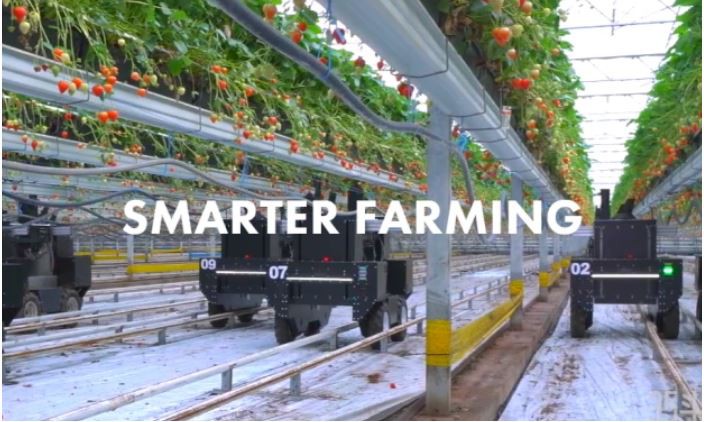
Source: Tortuga Agtech official website
1. Robots enter the picking area
The establishment of Tortuga is related to the founder's agricultural origin, the trend of agricultural robots, and the reality of the rapid and sharp decline in the labor force.
Agricultural roots: Before Tortuga was discovered by the media, co-founders Eric Adamson and Tim Brackbill spent three years learning about real farming, spending a lot of time with 14 growers in 24 different fields, according to Eric , which is a connection to his roots. Eric studied neuropsychology in college and became interested in social systems and their impact on the environment. After graduation, he first worked in the energy industry, but the extraction and production of the energy industry is more of a one-way connection between people and the environment. In the field of agriculture, people invest capital into the environment, the environment gives people feedback, and producers can continuously improve their technology and gain benefits through continuous interaction. This interaction is very impressive to Eric. Eric's grandfather was a farmer on the edge of Toronto, and all his relatives on his mother's side were Australian farmers. The family's agricultural roots gave Eric the idea of bringing advanced technology to the farm.
Agricultural robot trend: The application of robots in the agricultural field is the focus of startup companies and investment companies. Root Ventures, one of Tortuga Agtech's investors, invested in Momentum Machines, a company that uses robots to make burgers. Another investor, AME CLoud Ventures, invested millions in Zume Pizza, a pizza robot company.
Labor shortages: During the once-a-year harvest, farmers may encounter the following problems: understaffed; extreme weather; thin profits; tedious repetitive labor. Using robots to pick and sort ripe fruit allows farmers to focus on more valuable things. This idea is not new, but it is very difficult to implement.
First of all, it is necessary to identify: the fruit is different from other objects, and the fruit itself is different in size, shape, color, and degree of maturity. The robot needs to identify the ripe fruit instead of collecting the leaves on the side.
Secondly, be precise: high-value crops require robots to operate "carefully", which involves more precise technical knowledge.
Finally, for farmers, what they need is not high-tech that looks cool, but "plug-and-play" technology that can solve problems. "If farmers have to go through a few extra steps to use robots for tasks, adoption may be lower," said Tesla co-founder Marc Tarpenning, a board member at Tortuga's main investment firm Spero.
2. Financing of Tortuga Agtech
As a start-up company with only 39 employees, Tortuga Agtech has received a total of 28.4 million US dollars in five rounds of financing. Investors choose Tortuga Agtech inseparable from Tortuga's strong technical capabilities.
WeChat screenshot_20220209113004
Data source: crunchbase
In April 2021, Tortuga completed a 20 million Series A financing. The main investor of this financing is Lawis&Clark AgriFood Company, and other investors are Avidan Ross's Root Ventures, Spero Ventures, CeresPartners, Colorado Impact Fund, AME Cloud Ventures, Morado Ventures , Grit Ventures and Remus Capital.
Larry Page, general manager of Lawis&Clark AgriFood, said, "We have been researching the field of robotics and automation, and when we learned about Tortuga, we were convinced that they were the most exciting robotic harvesting company in the market. We believe Tortuga can become a leader in agricultural technology and automation. World leaders. They lead the field in key metrics such as picking speed, reliability, picking accuracy in complex environments.” Tortuga said the funds will be used for the construction of hundreds of robots, robotic picking and sorting capabilities increase and the hiring of more skilled personnel.
3. In addition to strawberries, we also need to pick tomatoes
In the future, labor scarcity will intensify. Once, 70% of the people on the earth were farmers, and it was not difficult to support themselves by planting and picking. Today, with only one percent of the farmers on the planet, agriculture is facing a crisis. It is an inevitable trend of agricultural development to help farmers increase their income by machines. Eric believes that machines will not replace labor, but make the use of labor more valuable.
Previously, Tortuga's robots were mainly used to pick strawberries, and will later expand to other specific fruits, such as grapes, blueberries, tomatoes, etc. The expansion of the business is built on improved technology, says co-founder Tim Brackbill: “We try to innovate faster than others in two areas: building the perfect picking size and creating nuanced picking algorithms that allow picking to scale to other crops."
Source: Tortuga Agtech official website
Last October, Tortuga's head of machine learning and data, Brian Heath, mentioned that Tortuga will focus on active learning systems for machines, a move that could take the harvesting activity of robots to a whole new level: machines can be used because of their ability to work in complex environments. Accurate picking to obtain virtual rewards, thereby reinforcing this behavior, and improving its own picking logic faster than humans. Brian Heath believes that the future of agriculture is for farmers to reduce product costs and improve product quality based on large amounts of data and actionable behavior to build a healthier society.
The field of agricultural robotics is expanding as the R&D maturity of startups increases. Such as the automated tractor company Bear Flag Robotics, which uses patented AI technology to equip tractors with automated systems, recently raised $7.9 million. For example, Australian company SwarmFarm Robotics raised $3.22 million in 2020 to develop its open platform for agricultural robots, which farmers can open to custom-program the robots as needed.
Eric believes that in addition to good technology, the development of agricultural robots requires engineering knowledge, customer service, industry knowledge, and large-scale operation capabilities. Many teams may handle one or two of these, but not all of them, which is why agriculture is more challenging than other fields. "I think there's been a separation between what can be commercialized, what's most desirable, and what can be mass-produced," Eric said.
About Manly
More than 12 years of experience in producing lithium battery cells and battery packs for various applications. Welcome to send your requiry to info@manlybattery.com