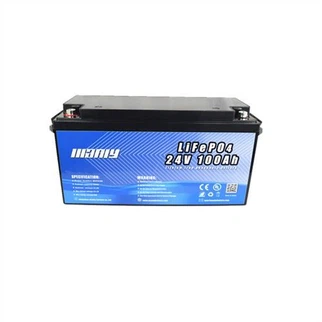
Lithium-ion batteries are the fastest growing type of battery in recent years, lithium-ion batteries are lightweight, high energy density, powerful, suitable for providing electric energy to a variety of devices, lithium-ion batteries have six significant advantages, the next small brief description of the six advantages of lithium-ion battery pack for your reference.
(1) high operating voltage
To graphite or petroleum coke and other carbon embedded lithium compounds instead of lithium metal as the negative electrode, will make the battery voltage is reduced. However, due to their low lithium potential, the voltage loss can be reduced to a minimum. At the same time, the selection of suitable embedded lithium compounds as the battery cathode, the selection of the appropriate electrolyte system (which determines the electrochemical window of the lithium-ion battery pack), can make the lithium-ion battery pack has a high operating voltage (-4V), much higher than the aqueous solution system battery.
(2) High specific capacity
Although the replacement of lithium metal with carbon material will reduce the material mass specific capacity, but in fact the lithium metal secondary batteries to ensure that the battery has a certain cycle life, the cathode lithium metal is usually more than three times the excess, so the actual reduction in the lithium-ion battery mass specific capacity is not large, and the volume specific capacity is almost no reduction.
(3) High energy density
The higher operating voltage and volume specific capacity determine the high energy density of secondary lithium-ion batteries. Compared with the widely used Ni-Cd battery and Ni-MH battery, the secondary lithium-ion battery has the highest energy density, and still has great potential for development.
(4) Good safety performance and long cycle life
With lithium metal as the anode of the battery is not safe because of repeated charging and discharging the lithium-ion battery anode structure changes, the formation of porous dendrites, at elevated temperatures, it and the electrolyte violent exothermic reaction, and dendrites can pierce the diaphragm, resulting in internal short circuit, while lithium-ion batteries do not have this problem, is very safe. In order to prevent the presence of lithium metal in the battery, charging to control the voltage, for insurance purposes, lithium-ion batteries are equipped with multiple safety devices. Lithium-ion batteries in the charging and discharging process of lithium ion insertion and de-embedding in the cathode and anode without any structural changes (in the insertion and de-embedding process lattice will have some expansion and contraction), and because the embedded lithium compounds are more stable than lithium metal, in the charging and discharging process will not form lithium dendrites, which significantly improved the safety performance of the battery, while the cycle life is greatly improved. Lithium-ion batteries in 1989 and 1990, respectively, by the U.S. Department of Transportation, Hazardous Materials Transportation Division and IAIT (International Air and Transportation Association) excluded from the hazardous materials.
(5) Small self-discharge rate
Lithium-ion battery pack adopts non-aqueous electrolyte system, and the embedded lithium carbon material is thermodynamically unstable in the non-aqueous electrolyte system. During the first charge and discharge process, the reduction of electrolyte will form a solid electrolyte intermediate phase (SEI) film on the surface of the carbon cathode, allowing lithium ions to pass but not electrons, and keeping the electrode active material of different charge states in a relatively stable state, so it has a low self-discharge rate.
(6) Clean and pollution-free
Lithium-ion battery pack does not contain toxic substances such as lead, fu, mercury, etc. Also, because the battery must be well sealed, very little gas is released during use and no pollution is caused to the environment. The solvent used to dissolve the binder in the manufacturing process can also be completely recycled, and large lithium-ion battery manufacturers such as Sony have been recycling lithium-ion batteries and materials (such as metal drills) since 1997. In addition, in 1996, Sony's lithium-ion batteries were certified to meet IS014001 international environmental standards.
Welcome to visit our company website: www.manlybattery.com, If you have requests or queries on batteries, please feel free to contact info@manlybattery.com. Thank you.