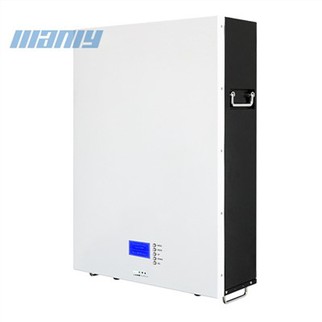
The storage battery is a very critical part of the solar power supply system, and it is also a major component of the cost of the solar power supply system. In recent years, the lithium battery solar power supply system has emerged and the momentum is booming.
So what factors affect the service life of lithium batteries? What's wrong with the short lifespan?
The service life of lithium batteries is mainly affected by two aspects, one is the external use conditions, and the other is the factor of the internal battery.
From the perspective of external use conditions, the factors that affect the service life of lithium batteries mainly include charging and discharging methods, charging and discharging cut-off voltage, charging and discharging rate, use temperature, and shelving conditions.
From the perspective of internal battery cell factors, the use of lithium batteries in RVs is often in the form of battery packs. The battery packs generally connect hundreds of battery cells in series and parallel. The consistency of the monomers is another important factor that affects the service life. factor. Mainly manifested as the inconsistency of parameters such as voltage, capacity, and internal resistance.
The influence of battery external use conditions on the service life of lithium battery
Charging and discharging methods: At present, most of the research on charging methods of lithium batteries is carried out based on the Maas theory, that is, to make the charging current as close as possible to the "best charging curve" of the Maas theory, so as not to cause harm to the battery. Some researchers have made a comprehensive comparison of several common charging methods and found that the constant current and constant voltage charging and the stepped constant current charging method overcome the shortcomings of constant current charging and constant voltage charging. This charging method has the lowest damage to the battery. widely used.
Charge-discharge rate, charge-discharge cut-off voltage: Under different charge-discharge rates, after the lithium battery is cycled for the same time, the capacity decay loss rate of the lithium battery is different. After changing the charge-discharge cut-off voltage, it is found through testing that the structure of the electrode material has also changed. The change in the structure of the positive electrode material and the thickening of the negative electrode surface film will cause a decrease in the number of lithium ions and blockage of the diffusion channel, which will cause the battery capacity to decline.
Operating temperature: Different lithium batteries have different optimal operating temperatures, too high or too low temperatures will affect the battery's service life. Studies have shown that the capacity decay of cycling batteries at room temperature is relatively slow, while at high-temperature conditions of 55°C and 65°C, the battery exhibits rapid failure behavior. When the temperature is lower than -10°C, the capacity of the battery decreases sharply. At the same time, the performance of the lithium battery will deteriorate at low temperatures, which is related to the decrease of the ionic conductivity of the electrolyte and the electrode material.
Shelving conditions: When the lithium battery is left unused, self-discharge, passivation of positive and negative materials, and decomposition of electrolyte will occur due to the nature of the battery itself. The instability of the negative electrode SEI performance will cause the negative electrode active material to rapidly decline, and it is easy to produce lithium metal precipitation. At the same time, different electrolyte components have different degrees of influence on the decline of the electrode material.
The impact of internal battery cell inconsistency on the service life of lithium batteries
The inconsistency of the monomer is mainly manifested as the inconsistency of parameters such as voltage, capacity, and internal resistance. Inconsistent single cells are used in series and parallel, and the life of the battery pack is always less than the life of the shortest single cell. Similar to the "barrel principle", the life of the battery pack is determined by the single battery with the shortest lifespan. It is very likely that the single battery with the shortest life span is the battery with a smaller capacity. The small capacity battery is fully charged and discharged every time, and the output is too strong, and it is very likely that it will reach the end of its life first. The life of a single battery ends, and a group of battery packs welded together will die.