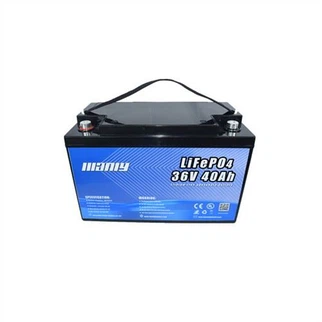
Which is better in thermal stability of lithium-ion iron phosphate battery or ternary lithium-ion battery? At present, the most commercially used ternary polymer lithium-ion battery and lithium-iron phosphate battery are the two kinds. Due to the unique material characteristics, the safety and stability of lithium-iron phosphate battery is higher, while the safety and stability of ternary lithium is relatively lower.
Which is better in thermal stability of lithium-ion iron phosphate battery or ternary lithium-ion battery?
The thermal stability of lithium-ion battery directly affects its safety performance in practical application, that is to say, the better the thermal stability, the less prone to spontaneous combustion or explosion accidents during use. According to the current industry data, the stability of ternary lithium ion battery is relatively poor, and the lithium ion battery of iron phosphate is relatively stable.
With the continuous development of ternary lithium ion battery technology, ternary materials with higher energy density gradually replace the stable lithium iron phosphate materials. Although three yuan material for ternary lithium ion batteries with higher energy density, but the thermal stability of safety performance becomes a bigger challenge, important is the high nickel material began to decompose at 200 ℃ degrees O2 release, it also led to the lithium ion battery bulge, develop into serious even thermal runaway burning explosion accident.
The phase transition temperatures of ternary lithium-ion batteries from lamellar phase to spinel phase are 245℃, 235℃, 185℃ and 135℃, respectively. The temperature range of spinel phase decreases gradually, indicating that the thermal stability of NCM decreases gradually with the increase of Ni content. More importantly, from NCM523 to NCM811, the thermal stability of the material presents a sharp decrease trend. With the material phase transition, a large amount of oxygen is released.
As you can see, NCM811 has the highest amount of oxygen release, several times more than the other materials. Current studies have shown that in the whole battery system, NCM phase transition often occurs on the surface of the particles, and the oxygen released will exist in the form of highly active singlet oxygen 1O2. The reaction of the latter with the electrolyte will not only release a lot of heat, but also produce a lot of gas, thus further deteriorating the battery safety.
Lithium-ion iron phosphate batteries are characterized by high safety, high rate of charge and discharge characteristics and long cycle life. In addition to taking long, charge and discharge function good, iron phosphate lithium-ion battery is the greatest strength of its safety, stable chemical properties of the lithium iron phosphate, high temperature stability, 700-800 ℃ will start happening differentiation, and in the face of the impact, such as acupuncture, short circuit conditions will not release oxygen, there will be no severe burning, high security features.
The significant weightlessness of lithium-ion iron phosphate batteries occurs only when the temperature is at least higher than 230℃, which indicates that the LFP has good thermal stability. The good thermal stability of LFP with olivine structure is due to the phosphoric acid group in its structure, and the Fe-P-O bond is far stronger than the Ni-O, Co-O and Mn-O bond in layered NCM, so LFP has better thermal stability than NCM.
Iron phosphate lithium-ion battery related to ternary lithium ion battery energy density is small, based on the material properties of the internal battery, lithium iron phosphate ion battery while the high temperature resistant, although these two kind of electrode material will arrive in a certain temperature, internal decomposition, but according to the ternary lithium materials, the use of water battery electrolyte solution. The chemical characteristics of lithium metal encounter heat is very active, and the battery's heat resistance temperature is basically about 200 degrees, and when the temperature reaches the heat resistance temperature, the chemical reaction of ternary lithium material will be more intense, and the electrolyte burns rapidly in high temperature use.
Lithium iron phosphate has the best thermal stability of any lithium-ion battery used in cars: the battery's internal chemical composition only begins to break down when the battery temperature is higher than 500 degrees. In contrast, ternary lithium-ion batteries are less than 300 degrees, and some high-nickel batteries have thermal runaway temperatures of less than 200 degrees, so lithium-ion iron phosphate batteries have a lower risk of spontaneous combustion during collisions and rapid charging.
In general, if the product focuses on the consideration of high temperature safety, reliability, cycle life, to choose lithium ion iron phosphate battery. If the product focuses on the consideration of energy density, low temperature performance, cost-effective, to choose three lithium ion battery.