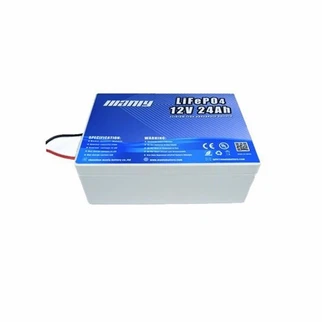
Safety is an important factor hindering the development of lithium batteries, in recent years on the lithium battery incineration and bursting of the incident reported very frequently, lithium battery equipment if improperly used, there will always be a time to burst. Today, lithium battery-related products are increasingly integrated into our days, it is necessary to understand the handling of lithium battery fires.
Why lithium batteries will burst and catch fire? Lithium battery is a small, light weight battery and enough power to continue to charge and discharge conditions still run outstanding. Although few accidents occur, but the accidents that do occur are obvious, or cause a fire, resulting in a burst. How does the lithium battery incinerate? For example, when a lithium battery has an internal or external short circuit, its interior will, within a short period of time, release a large amount of heat and the temperature rises dramatically, resulting in uncontrolled heat. Then, this flammable electrolyte will be ignited, eventually leading to a battery fire or burst.
Lithium-ion batteries typically contain a metal coil and a flammable lithium-ion liquid. Tiny pieces of metal float in the liquid. The contents of the battery are under pressure, so if a metal fragment pierces the partition that insists on the separation of the object, or if the battery is pierced, then the high temperature that occurs when lithium reacts violently with the water in the air can sometimes cause the lithium battery to catch fire.
Why lithium batteries burst into flames and what can be done about it
Lithium batteries provide high power output with minimal weight. The battery assembly is designed to be lightweight, which means that there is a thin partition between the battery and the thin case. The partitions and coatings are quite fragile and they can be punctured. If the battery is damaged, a short circuit can occur. A single spark can also ignite the highly reactive lithium. Another possibility is that the lithium battery may be heated to the point of thermal runaway. Here, the heat of the contents of the battery pressure, it is possible to cause the lithium battery burst.
Prevent lithium-ion batteries from catching fire or bursting approach to find the mechanism of thermal bursting of lithium-ion batteries, the mechanism of thermal bursting of lithium batteries is: when the battery is subjected to thermal shock, overcharge, overdischarge, short circuit, vibration, extrusion and other states of disorder, the battery's internal active material and electrolyte and other components will occur between chemical and electrochemical reactions, a large amount of heat and gas, causing the battery to heat up, if the lithium-ion battery If the rate of heat generation inside the lithium-ion battery is greater than the rate of heat loss, the reaction temperature in the system will continue to rise, and when the heat and internal pressure accumulate to a certain level, it will cause the battery to burn or burst.
Nano-engineers at the University of California, San Diego, have developed a safety feature that prevents lithium metal batteries from heating up quickly and catching fire in the event of an internal short circuit. The team made clever adjustments to the part of the lithium battery known as the compartment, which is a barrier between the positive and negative electrodes of the lithium battery, so that the energy (aka heat) activity that accumulates inside the battery slows down when the battery is shorted. Lithium metal batteries present a needle-like structure of dendrites on the anode after repeated charging. Over time, the dendrites grow long enough to penetrate the barrier and build a bridge between the anode and cathode, causing an internal short circuit. When this happens, the electron activity between the two electrodes is out of control, causing the lithium battery to immediately overheat and stop working.
1. Add flame retardant to the existing electrolyte. However, in order to complete the flame retardancy, it is necessary to add a large amount of flame retardant to the electrolyte, which will correspondingly reduce the ionic conductivity of the electrolyte and obviously affect the electrochemical performance and energy density of the lithium battery.
2, through the addition of special maintenance circuit to achieve maintenance, such as: to prevent lithium-ion battery overcharge, the installation of PTC polymer switch or explosion-proof safety valve in the battery's safety cap.
3, the thermal stability of lithium batteries is related to the type of cathode material, electrolyte. After optimizing the synthesis conditions, improve the synthesis method, synthesize the cathode material with good thermal stability.
4, the appearance of carbon data weak oxidation, such as: reduction, doping, appearance modification, etc.; or the use of spherical, fibrous carbon anode material to improve the thermal stability of lithium batteries.
Summary: In order to better play the advantages of lithium batteries, to prevent the huge losses caused by fire incidents, it is necessary to cut the bottom of the real cause of its fire to make preventive measures, the correct use, to prevent losses.
If you have requests or queries on batteries, please feel free to contact info@manlybattery.com