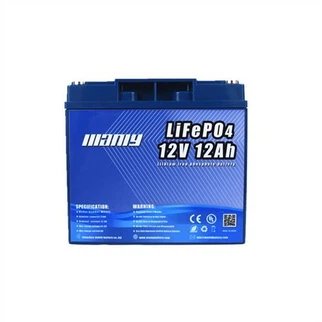
Lithium cobalt acid, lithium manganate, lithium iron phosphate and lithium polymer battery safety comparison. Many customers have a lot of controversy about the safety of power batteries, compared to lithium cobalt, lithium polymer and lithium manganate, lithium iron phosphate is the most obvious advantage of a very high safety factor, support for fast charging (high current charging) and a wider operating temperature range.
From the perspective of the mainstream technology of lithium-ion batteries currently in use, there are several types of lithium cobaltate, lithium manganate, lithium iron phosphate and lithium polymer batteries, their different materials and structural characteristics will have an impact on the battery preparation technology and use, thus bringing different safety.

First, lithium cobalt acid battery: lithium cobalt acid battery safety is poor, the cost is very high, mainly used for small and medium-sized cells, widely used in laptops, cell phones, MP3/4 and other small electronic devices, nominal voltage of 3.7V.
The most important feature in the preparation is that there is still a large amount of lithium ions left in the positive electrode after a full charge. In other words, the negative electrode can not accommodate more lithium ions attached to the positive electrode, but in the overcharged state, the excess lithium ions on the positive electrode will still swim to the negative electrode, because it can not completely accommodate the formation of lithium metal on the negative electrode, because this lithium metal is a dendritic crystal, and therefore is called dendrites, once the formation of dendrites, it will give the opportunity to pierce the diaphragm, diaphragm piercing will form an internal short circuit.
Since the main component of the electrolyte is carbonate, the flash and boiling points are low, so that at higher temperatures it will burn or even explode. Control the formation of lithium dendrites is easier on small-capacity lithium batteries, therefore, lithium cobalt acid batteries are currently limited to small-capacity batteries such as portable electronic devices, and can not be used for power batteries.
Second, lithium polymer batteries: in the actual available theoretical specific energy has greatly improved, compared to lithium cobalt acid batteries, can better play the role of high capacity, but from a material point of view, lithium polymer batteries also use lithium cobaltate and organic electrolyte, so it does not fundamentally solve the safety problem. From the point of view of use, the battery will generate excessive current if a short circuit occurs. The electrolyte of Li-polymer battery is colloidal, not easy to leak, which also excludes the possibility of leakage, but will therefore occur more violent combustion, therefore, spontaneous combustion is the biggest hidden danger of Li-polymer battery.
Polymer lithium battery in the structure of the aluminum-plastic soft packaging, as opposed to the metal shell of the liquid cell, in the event of a safety hazard, the liquid cell is prone to explosion, while the polymer cell will at most only gas drum.
Third, lithium manganate battery: lithium manganate battery material has certain advantages, it can ensure that in the fully charged state, the lithium ion of the positive electrode can be completely embedded in the negative carbon hole, rather than like lithium cobalt acid will have a certain residue in the positive electrode, which fundamentally avoids the generation of dendrites. Because the solid structure of lithium manganate makes its oxidation performance much lower than that of lithium cobaltate, even if there is an external short circuit (instead of an internal short circuit), the precipitation of lithium metal can be basically avoided to cause combustion and explosion.
Lithium manganate battery not only has a huge market space, but also has a huge technical development space. Compared with ternary materials, lithium iron phosphate and other cathode materials, lithium manganate has the advantages of abundant resources, low cost, no pollution, good safety, good multiplier performance, etc., is the ideal cathode material for power batteries.
Fourth, lithium iron phosphate battery: this is an ideal power battery, can be used for electric tools and power cars, etc., the theoretical capacity of lithium iron phosphate is 170mAh / g, made of materials that can actually reach the capacity of 160mAh / g. In terms of safety, lithium iron phosphate crystal P-O bond is solid, difficult to decompose, even at high temperatures or overcharge will not be as hot as lithium cobaltate structure collapse or Formation of strong oxidizing substances, so it has a good safety. Lithium iron phosphate battery thermal peak can reach 350 ℃ -500 ℃, while lithium manganate and lithium cobalt acid battery is only about 200 ℃.
The safety performance of lithium iron phosphate batteries is very good, not easy to burn and explode and other dangers. Coupled with a reasonable structural design, its safety has been further improved, so the battery does not burn and explode in the case of impact, pinprick, short circuit, etc.
Lithium battery safety evaluation method
Lithium battery safety assessment instruments
In lithium battery safety research, calorimetry is the main instrument used. The most commonly used calorimeter is the Accelerated Calorimeter (ARC), a new type of thermal analysis instrument recommended by the United Nations for hazardous materials assessment, which can provide time-temperature-pressure data for chemical reactions under adiabatic conditions.
ARC Safety Assessment Methodology
ARC can provide a near adiabatic environment by precise temperature tracking and avoiding heat exchange between the sample under test and the environment, thus mainly testing and analyzing the exothermic behavior of the sample under test. In addition to testing thermal runaway, by using ARC to provide an adiabatic environment, ARC can be used in conjunction with DC constant current source and charging and discharging equipment to test the specific heat capacity of the battery and the adiabatic temperature rise during charging and discharging.
The safety of lithium batteries is one of the most important concerns for power batteries. The safety of the battery and the design of the battery pack, abuse conditions have a great relationship. For single cell batteries, safety is not only related to the cathode material, but also related to the negative electrode, diaphragm and electrolyte.
Summary: The above is a comparison of lithium cobalt acid, lithium manganate, lithium iron phosphate and lithium polymer battery safety, personal opinion, the safety of lithium batteries, the need to examine the four levels from the battery cell, PACK, system, functional safety. If the safety of lithium batteries is not fundamentally solved, the sales in the market will certainly go stumbling.
If you have any demands in batteries, please feel free to contact info@manlybattery.com